HOME > Service > CFD Modeling

CFD Modeling

CONTACT OUR EXPERTS

Computational Fluid Dynamics (CFD) Analysis

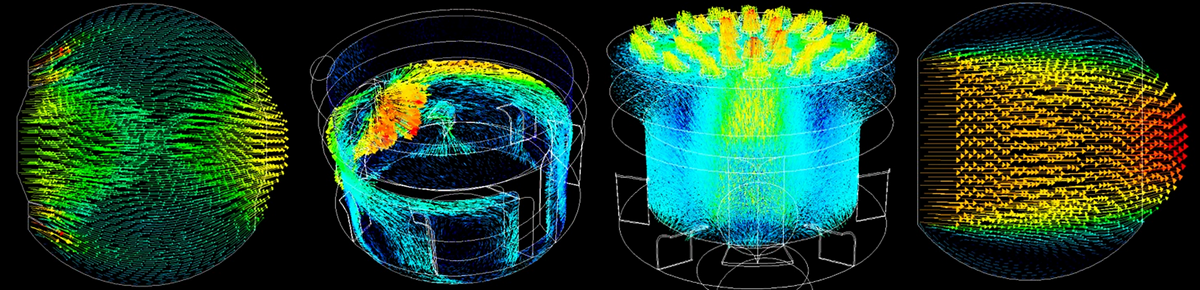
Computational Fluid Dynamics (CFD) analysis is a transformative engineering tool that delivers time-resolved, three-dimensional visualization and quantification of fluid flow characteristics across complex process equipment. Leveraging high-performance computing to solve Navier-Stokes equations across meshed domains of up to millions of computational cells, CFD enables the prediction of multiphase flow behavior (gas-liquid, gas-liquid-solid) under both pilot-scale and full-scale operating conditions—making it an indispensable component of Saiptech's product development and process optimization workflow for distillation, separation, and reaction equipment.

Saiptech CFD Analysis for Multiphase Flow in Process Equipment

Typical Applications

  • Tray deck flow analysis – Optimization of liquid/vapor distribution on sieve/valve/bubble cap trays; prediction of weeping, entrainment, and channeling to maximize tray efficiency in crude oil distillation and solvent recovery columns.
  • Horizontal 2 and 3 phase separators – Simulation of oil-water-gas separation dynamics; optimization of inlet device design and baffle configuration to minimize residence time and maximize phase separation efficiency in upstream oil & gas processing.
  • Cyclones, demisting, hydrocyclones – Prediction of tangential velocity profiles and pressure drop; design validation of cyclonic separators for mist removal (≥99.9% efficiency) in flue gas treatment and amine scrubbing systems.
  • Vertical 2 and 3 phase gas-liquid separators (scrubbers) – Analysis of liquid carry-over and gas breakthrough; optimization of mesh pad/ vane pack geometry for acid gas removal in petrochemical flare systems.
  • Knock out drums – CFD-driven design of inlet diffusers and droplet impaction surfaces to prevent liquid carry-over into compressors in natural gas processing plants.
  • Glycol contactors – Simulation of glycol spray distribution and gas-liquid contact efficiency; optimization of packing geometry to maximize water removal from natural gas streams (dew point depression to -40°C).

Saiptech's decades of practical engineering experience, combined with real-world plant performance data from over 500+ installed separation systems, has enabled the development of validated design correlations for distillation and separation internals. By integrating CFD analysis with operational data, we address the critical challenge of continuous performance improvement: CFD simulations quantify flow inefficiencies (e.g., dead zones in packed beds, uneven liquid distribution on trays) that cannot be identified through empirical methods alone, enabling data-driven design optimizations to increase separation capacity by 10-20% or reduce energy consumption by 5-15%.

A unique competitive advantage is Saiptech's ability to integrate CFD output with Finite Element Analysis (FEA) software, enabling concurrent mechanical and fluid dynamic validation of equipment designs. This integrated approach allows us to quantify mechanical stresses on internals (tray supports, packing grids, separator baffles) caused by high-velocity fluid flow or thermal expansion—ensuring structural integrity under upset conditions (e.g., slug flow, pressure surges) and eliminating the need for costly post-installation modifications. This holistic design methodology guarantees both process performance and mechanical reliability for the full lifecycle of the equipment (15-20 years).

Contact Our Experts

Dear Customer,
If you have any enquiry on our product & service, pls drop e-mail to saiptech@saiptech.com with your specific requirement, our team will contact you in time.


Yours Sincerely


Saiptech Co., Ltd